
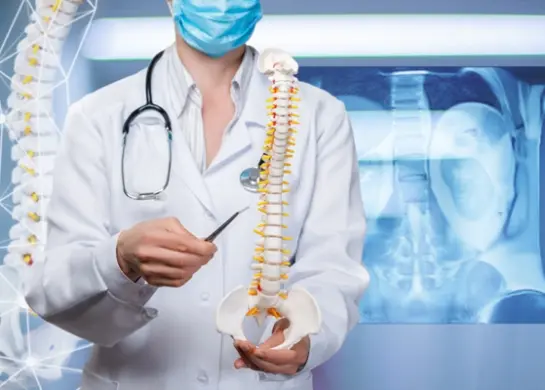
Spine surgery refers to a group of surgical procedures used to treat certain problems affecting the bones, discs, nerves, and other structures of the spine. These procedures may be considered when spinal conditions cause persistent pain, nerve compression, instability, or other problems that cannot be adequately managed with non-surgical treatment.
Advances in surgical techniques and medical technology have introduced approaches that may involve smaller incisions in selected cases. However, the appropriate procedure, expected results, and recovery time depend on the underlying condition and the patient’s overall health.
What Is the Spine?
The spine, also called the vertebral column, supports the body, helps maintain posture, and protects the spinal cord and associated nerves.
It is divided into several regions:
- Cervical spine: The neck region.
- Thoracic spine: The upper and middle back.
- Lumbar spine: The lower back.
- Sacrum: The lower part of the spine that connects with the pelvis.
- Coccyx: The tailbone.
Problems affecting the discs, vertebrae, joints, ligaments, or nerves may cause pain, restricted movement, numbness, or muscle weakness. Some conditions may require surgical assessment.
Why Is Spine Surgery Needed?
Spine surgery may be recommended for selected conditions when symptoms are severe, nerve function is at risk, the spine is unstable, or non-surgical treatment has not provided sufficient relief.
1. Herniated Disc or Disc Prolapse
A herniated disc occurs when the soft inner material of a spinal disc protrudes through its outer layer. If it irritates or compresses a nearby nerve, it may cause pain, tingling, numbness, or weakness.
Disc prolapse can occur in the cervical spine or lumbar spine. Depending on the symptoms and clinical findings, surgery may be considered to relieve pressure on the affected nerve.
2. Spinal Canal Stenosis
Spinal canal stenosis refers to narrowing of the spaces through which the spinal cord or spinal nerves pass. It may develop because of age-related changes, thickened ligaments, enlarged joints, or other structural changes.
Depending on its location, stenosis may affect the cervical, thoracic, or lumbar spine. Symptoms can include pain, numbness, weakness, or difficulty walking. Surgery may be considered when compression causes significant symptoms or neurological problems.
3. Spondylolisthesis
Spondylolisthesis occurs when one vertebra slips relative to the vertebra below it. In some cases, this can contribute to back pain, spinal instability, or nerve compression.
Treatment depends on the degree of slippage, symptoms, and spinal stability. Selected patients may require a procedure to decompress nerves and, where indicated, stabilise the spine.
4. Spinal Tumours
Tumours can develop in or around the spinal bones, spinal cord, or nearby tissues. They may be benign (non-cancerous) or malignant (cancerous).
Treatment depends on the tumour’s type, location, size, effect on surrounding structures, and overall clinical situation. Surgery may be required in selected cases to remove tissue, relieve compression, obtain a diagnosis, or stabilise the spine.
5. Spinal Injury or Trauma
Injuries such as spinal fractures or dislocations can sometimes damage the spinal cord or nerves and affect spinal stability.
Depending on the injury, treatment may involve observation, immobilisation, or surgery to decompress neural structures and stabilise the affected area.
6. Spinal Vascular Malformations
Abnormal connections or formations involving blood vessels near the spinal cord may sometimes require specialist treatment. The management approach depends on the type and location of the vascular abnormality and may involve surgery or other specialist procedures.
What Are the Different Types of Spine Surgery?
The type of spine surgery depends on the condition being treated, the affected spinal region, and the patient’s symptoms and imaging findings.
1. Lumbar Microdiscectomy
A lumbar microdiscectomy is a procedure used to remove the portion of a herniated disc that is compressing a nerve in the lower back. The aim is to relieve nerve pressure and improve associated symptoms, such as pain travelling down the leg.
2. Endoscopic Discectomy
Endoscopic discectomy uses a small camera and specialised instruments to access and remove selected portions of a herniated disc. It may be suitable for certain patients, depending on the disc problem and clinical findings.
Not every disc prolapse is appropriate for an endoscopic procedure.
3. Decompression for Lumbar Spinal Stenosis
Lumbar decompression surgery aims to create more space for compressed spinal nerves in the lower back. The surgeon removes or modifies selected tissues that are contributing to the narrowing.
The exact technique depends on the location and extent of the stenosis.
4. Laminectomy
A laminectomy involves removing part or all of the lamina, a portion of the vertebra, to increase space around the spinal cord or nerves.
It may be performed for certain cases of spinal stenosis or other conditions causing compression. Additional procedures may be required if the spine is unstable.
5. Transforaminal Lumbar Interbody Fusion (TLIF)
TLIF is a spinal fusion procedure used in selected conditions involving spinal instability or other problems that require stabilisation.
The procedure involves removing disc material from the affected level, placing a spacer or bone graft in the disc space, and using fixation devices when indicated to help stabilise the vertebrae while fusion develops.
6. Cervical Discectomy and Plating
Cervical discectomy involves removing a damaged disc in the neck to relieve pressure on nearby nerves or the spinal cord. In selected cases, the surgeon may perform a fusion using a spacer or bone graft and a plate to help stabilise the affected spinal level.
The appropriate technique depends on the underlying cervical spine condition.
7. Cervical Laminectomy and Lateral Mass Fixation
This procedure may be considered in selected cases of cervical spinal cord compression, particularly when additional stabilisation is necessary.
A laminectomy creates more space around the spinal cord, while lateral mass fixation uses screws and connecting rods to help stabilise the cervical spine.
8. Cervical Laminoplasty
Cervical laminoplasty is a procedure designed to increase the space available for the spinal cord in selected patients with cervical spinal stenosis.
Unlike a conventional laminectomy with fusion, laminoplasty reshapes or opens part of the vertebral arch to create additional space while preserving some spinal movement. Its suitability depends on the patient’s anatomy and condition.
9. Craniovertebral Junction Surgery
The craniovertebral junction is the area where the skull meets the upper cervical spine. Conditions affecting this region may involve abnormal bone structure, instability, compression, or other complex problems.
Surgery may be required in selected cases to relieve compression or stabilise the area. These procedures require careful assessment because of the important nerves and blood vessels in the region.
What Are the Risks of Spine Surgery?
As with other major surgical procedures, spine surgery carries potential risks. These vary depending on the operation, the patient’s health, and the condition being treated.
Possible complications include:
- Nerve or spinal cord injury: This may lead to new or worsening weakness, numbness, or other neurological problems.
- Bladder or bowel problems: Changes in urinary or bowel function may occur in some cases and require urgent medical assessment.
- Wound complications: Fluid accumulation, bleeding, or problems with wound healing may develop.
- Infection: An infection may affect the surgical wound or, less commonly, deeper tissues.
- Persistent symptoms: Pain, numbness, or other symptoms may not resolve completely.
- Other procedure-specific complications: These may include problems with spinal stability, fusion, or implanted hardware, depending on the operation.
Your surgeon should explain the specific risks, expected benefits, and alternatives relevant to your condition before surgery.
What Is Recovery Like After Spine Surgery?
Recovery depends on the type of surgery, the spinal region treated, the patient’s general health, and whether any complications occur.
Following an uncomplicated procedure, many patients begin gradual movement as advised by their medical team. Some procedures involve shorter recovery periods, while spinal fusion and more complex operations may require a longer period of healing.
Recovery may include:
- Following wound-care and activity instructions.
- Taking prescribed medicines as directed.
- Gradually returning to walking and everyday activities.
- Attending follow-up appointments.
- Following a physiotherapy or rehabilitation plan when recommended.
- Avoiding lifting, twisting, or other activities restricted by the surgeon.
Seek urgent medical attention if you develop new or worsening limb weakness, loss of bladder or bowel control, difficulty passing urine, fever with worsening wound symptoms, or other concerning symptoms after surgery.
Conclusion
Spine surgery includes several procedures used to treat selected conditions affecting spinal discs, bones, nerves, and stability. Procedures such as microdiscectomy, laminectomy, spinal decompression, and spinal fusion address different problems and are not interchangeable.
The most appropriate treatment depends on the diagnosis, symptoms, examination findings, imaging results, and the patient’s overall health. An assessment by a qualified spine specialist can help determine whether surgery is appropriate and explain the expected recovery, potential benefits, and risks.